
Daily Nourishment for Maundy Thursday: Washing Feet and Loving One Another
Daily Nourishment Read Time: 50 seconds
Pause/Prompt/Practice Time: 10-15 minutes
Palm Sunday marked the beginning of Holy Week in the Christian tradition. SDW Daily Nourishment will provide Pauses, Prompts, and Practices to help readers explore the meaning of this liturgical season and notice personal connections between these specific days and our present realities. All are welcome to engage with the art and ideas below.
“Human beings characteristically see patterns and make connections. Christians ought to celebrate that faculty and receive it as part of how we find our way to God.” - Lauren Winner, “Encountering Art and Encountering God”

Pause.
On this night, Jesus gathers with his friends, breaks bread, and kneels to wash their feet. He loves them to the very end.
Linger over the art by Laura James below while taking slow, deep breaths.
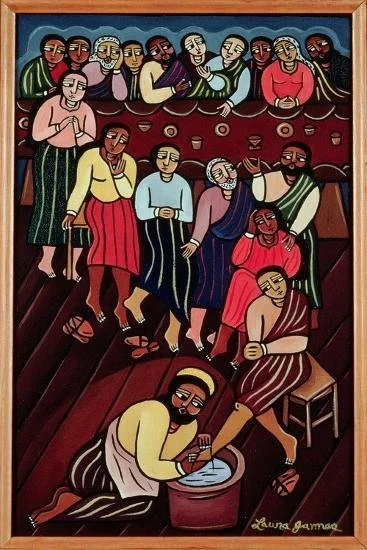
Washing Feet by Laura James


Practice.
For 10 minutes, respond to the art and poem. How have you received unconditional love from God or a person? How have you shown others love over the past several weeks?
How do you want to love others better?
How do you want others to love you better?
You can take notes or make lists or draw a picture.
Want More?
From “Maundy Thursday: Lauren Winner on why prayer can jolt us into paying attention” excerpts from an article published by The Washington Post that was adapted from Wearing God: Clothing, Laughter, Fire, and Other Overlooked Ways of Meeting God
It is Holy Thursday, near the end of Lent, the day we remember Jesus’s Last Supper. Jesus took a towel and a basin and washed his disciples’ feet, and he told them to love one another. After supper, he went into the garden of Gethsemane and prayed.
My friend Isaac and I are driving, as we do every year, to a small, ineffectual protest at an immigration detention center in Cary, N.C. Every year, a stalwart band of Holy Week pilgrims gathers in a grocery store parking lot in Cary, and we process to the immigration detention center and set up two chairs. One chair is occupied by whoever is having her feet washed, and the other is left empty, as a reminder of the people who are absent from us — from our families and our churches — because of current immigration law.
I attend this foot washing because I think it is good to put myself near a space of arrest and incarceration on the days when we commemorate Jesus’s arrest and incarceration. I attend as a tiny witness to my belief that regardless of national policy, Christians are called to welcome the stranger in our midst. I attend because a few years ago, in a season of my life when I felt very far away from God, the footwashing service outside the detention center called me back into something like recognition of God’s nearness and God’s majesty. Also, I attend this service every year because it is one of the few times I get to see Isaac. He lives a mile away from me and we ride over to Cary together, and I may not see him for five or six more months, but I know we will have this one car ride to catch up on our lives…
At the detention center, Isaac leads us in a liturgy, as he does every year, and he offers a short sermon, as he does every year. He says he is tired of coming here. He is tired of it because nothing ever changes. Protest, like prayer, can become tedious. While Isaac is talking, my mind flashes forward 40 years, to him and me in our 70s, still making this pointless annual drive to Cary. It is both a deeply depressing thought and a hopeful thought. Part of the hope is this: if we are still coming here, that means we are still praying. This is Isaac’s point, I think. Protest ultimately is prayer, in part because in protest you are ultimately protesting against God. Why has God not kept God’s promises? Perhaps a life of contemplation is the most profound resistance there is — certainly it is more profound than my annual appearance at this foot washing…
I do not want to instrumentalize prayer. Prayer, finally, is not productive, and it is not a means to an end. And yet, I know from my own halting two decades of prayer — of on-again, off-again prayer, of prayer that is consistent and prayer that is sporadic — that it is precisely contemplation that is turning me into a person with the capacity to attend to God and to God’s world. How can I become a person who pays enough attention that I might notice something and then act in response? Prayer, lectio divina, reading the same passage of the Bible again and again and trying to notice what God has for me to notice; sitting in silence; walking in silence; repeating the psalms over and over — these habits might teach me how to pay attention.
Lauren F. Winner is the author of “Wearing God: Clothing, Laughter, Fire, and Other Overlooked Ways of Meeting God” (HarperOne, an Imprint of HarperCollinsPublishers) from which this article is adapted. She is author of many other books, including “Still,” “Girl Meets God” and “Mudhouse Sabbath.” An Episcopal priest, she teaches at Duke Divinity School in Durham, North Carolina.
*
Become an SDW Insider and reserve your copy of Spiritual Direction for Writers: Everyday Rituals for Your Writing Life AND receive access to the All of Life Is the Writing Life Deep Dive online course—a preorder perk that explores how the mantra “All of life is the writing life” shows up in the Spiritual Direction for Writers book.
NEW: SDW Book Notes—A place for book preorder links, updates, resources, notes, and musings
Group Spiritual Direction for Creative Souls
Flourish Anyway with Rhythms, Rituals, & Retreats
Today’s Daily Nourishment was provided by Charlotte Donlon.
*Please help us protect our intellectual property, our creative process, and the integrity of our work. Spiritual Direction for Writers® Daily Nourishment is covered under the Spiritual Direction for Writers® trademark. You are welcome to share this link with others, but any other use (written or spoken) is prohibited without written permission from Charlotte Donlon.